Andalusia, Spain
A Short History of Andalusia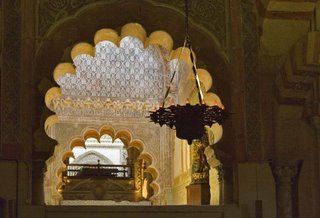
As a deviation from the life in Paris, JustmeinParis took a vacation in Andalusia, Spain. It is very beautiful region and the cities really show the influence of history. There are huge “monuments” such as Alhambra in Grenada that was always an Arabic palace and fortress. Others started as Christian churches before the 6th century like Mezquita in Cordoba and when the Arabs arrived starting in the year 711,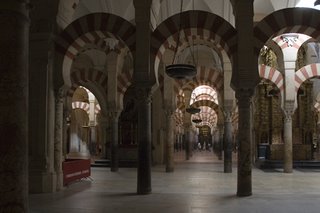 they built mosques sometimes over and as additions of the original churches. When the Arabs were pushed back some eight hundred years later, the Christians again modified the mosques with additions or other changes. One can certainly see the Arab influence in the architecture. The Arabic palaces are quite beautiful such as the Torre del Oro and Giralda towers in Seville.
 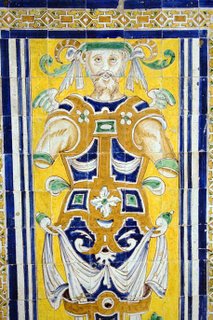 They are much like those I saw in Morocco, with colorful ceramic tiles and arches. Certainly there is a long history in this part of Spain.
Seville, Spain
In Seville, you can visit the fabulous palace Alcazar where Ferdinand and Isabella were married and where later Queen Isabella gave Christopher Columbus the funding and approval for a voyage to the Indies by going west.
In the Cathedral of Seville, there are the supposed remains of Christopher Columbus. There is a set of statues carrying a coffin with a gold box inside containing the remains. However, Le Guide du Routard says that Columbus has two sets of remains, one in Seville and one in Santiago, Dominican Republic. I visited Santiago but do not remember visiting the site where Columbus was interred. Another guidebook says that the DNA of the remains in Seville was compared with the brothers of Columbus (whose remains are known) and apparently it is not Columbus but an unknown even older unknown male ! Yet another article describes the remains as the illegitimate son of Columbus. There is still another article that says the results suggest there are that there is more than one person in this famous gold box. The officials in Dominican Republic have not allowed examination of the remains there. Oh, well, a little mystery during this year 2006, the 500th anniversary of the death of Columbus. Who is enterred in the gold box in Seville, Spain ? The answer is not as obvious as Groucho Marx's question, “who is buried in Grant’s tomb ?” Expect an update from the research team.
Hillside Villages and Houses of White
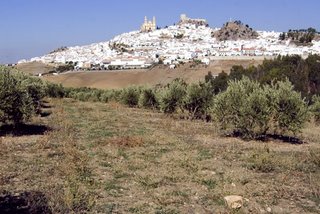 The small Andalusian villages with all white houses and buildings are quite a site. These villages started as a fortress or chateau on a hill and perhaps a church surrounded by walls. Sometimes these villages are found along cliffs such as Ronda, Spain that negate the need for walls. Later as these villages grew, the houses clustered around the central hillside. The white color reflects the blazing summer sun.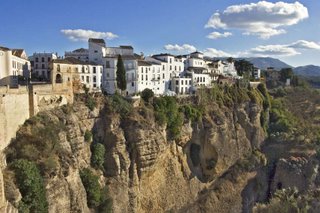
Spanish Agriculture
The Spanish country is beautiful with many, many trees of olives, almonds and oranges. The mountains are not so high in Andalusia and often covered with agricultural trees. There is an air of being hot because of the dried grasses and Mediterranean shrubs and plants. During the first part of October, the temperature was quite pleasant, into the high 80Fs. During the 10 days, it never rained.
Spanish Life
Spanish daily life is a little different that what I am used to. The mornings seem normal enough. I did discover a great breakfast with coffee and milk, orange juice and toast with a spread of fresh tomato sauce with olive oil drizzled over the top. Mmmm! In fact the orange juice is wonderful, (almost) always fresh and fairly cheap. There were orange trees as far as the eye could see around Valencia, Spain, and sure this is where Valencia oranges originated.
Lunchtime is quite late, beginning around 2pm and lasting through to the end of the siesta around 5 or 6pm. Lunch was simple, large platters of cold cuts, olives and bread, sometimes the olives or a small snack are free with the drinks.
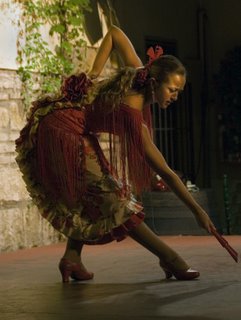 After siesta, normal stores/shops open at 6pm but the restaurants often do not open until 8pm or 8:30pm. Tapas bars often open a little later than restaurants. Mmmmm. I really enjoyed the tapas bars. One can buy small plates of various items such as fish, meats, vegetables, in sauces, simple or perhaps fried. These dishes can be bought together to assemble an entire dinner or just a snack. The Spanish sometimes ‘bar hop’ from one tapas bar to another until around midnight.
Flamenco
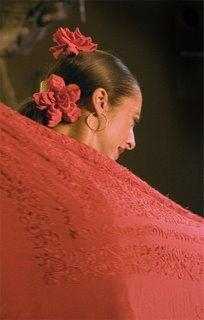
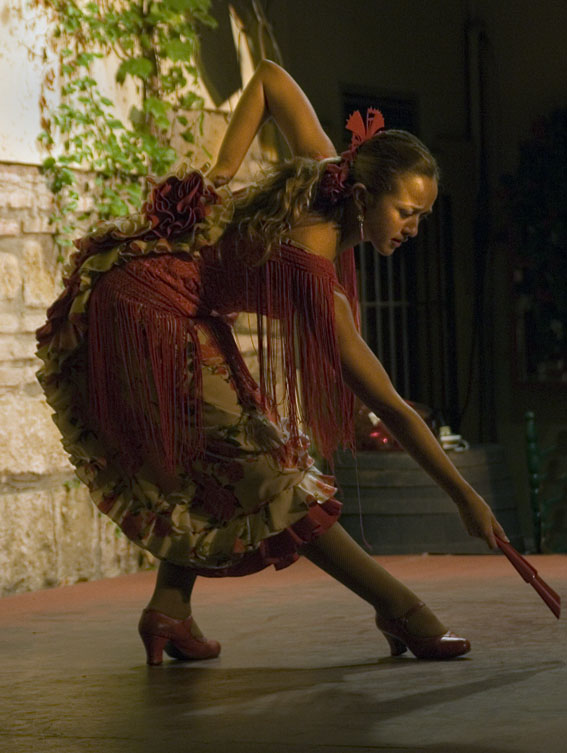
There are many Flamenco shows in Andalusia, some very much for tourists but in Seville there is a biennial Flamenco festival and I am sure the level is quite high (there were no tickets left). There are many types of Flamenco but I could not recognize the styles in the two shows I saw.

As a deviation from the life in Paris, JustmeinParis took a vacation in Andalusia, Spain. It is very beautiful region and the cities really show the influence of history. There are huge “monuments” such as Alhambra in Grenada that was always an Arabic palace and fortress. Others started as Christian churches before the 6th century like Mezquita in Cordoba and when the Arabs arrived starting in the year 711,
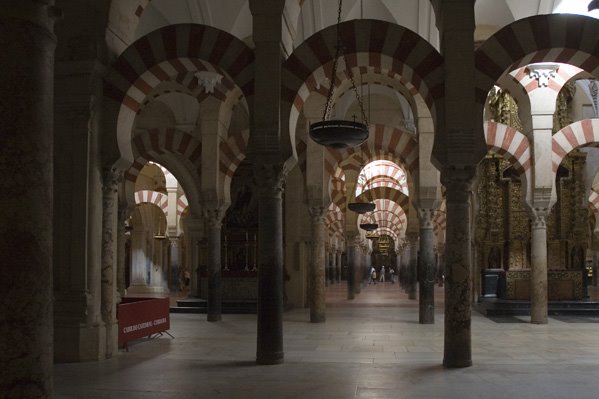 they built mosques sometimes over and as additions of the original churches. When the Arabs were pushed back some eight hundred years later, the Christians again modified the mosques with additions or other changes. One can certainly see the Arab influence in the architecture. The Arabic palaces are quite beautiful such as the Torre del Oro and Giralda towers in Seville.
 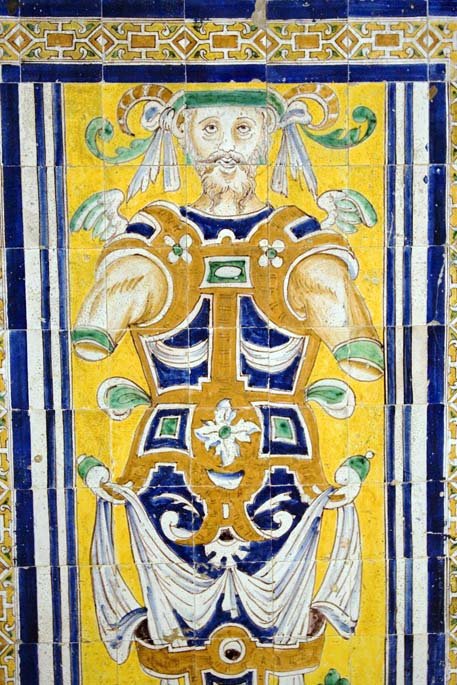 They are much like those I saw in Morocco, with colorful ceramic tiles and arches. Certainly there is a long history in this part of Spain.
Seville, Spain
In Seville, you can visit the fabulous palace Alcazar where Ferdinand and Isabella were married and where later Queen Isabella gave Christopher Columbus the funding and approval for a voyage to the Indies by going west.
Mysteries of Christopher Columbus
In the Cathedral of Seville, there are the supposed remains of Christopher Columbus. There is a set of statues carrying a coffin with a gold box inside containing the remains. However, Le Guide du Routard says that Columbus has two sets of remains, one in Seville and one in Santiago, Dominican Republic. I visited Santiago but do not remember visiting the site where Columbus was interred. Another guidebook says that the DNA of the remains in Seville was compared with the brothers of Columbus (whose remains are known) and apparently it is not Columbus but an unknown even older unknown male ! Yet another article describes the remains as the illegitimate son of Columbus. There is still another article that says the results suggest there are that there is more than one person in this famous gold box. The officials in Dominican Republic have not allowed examination of the remains there. Oh, well, a little mystery during this year 2006, the 500th anniversary of the death of Columbus. Who is enterred in the gold box in Seville, Spain ? The answer is not as obvious as Groucho Marx's question, “who is buried in Grant’s tomb ?” Expect an update from the research team.
Hillside Villages and Houses of White
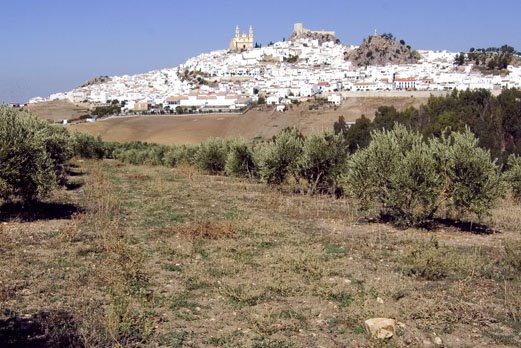 The small Andalusian villages with all white houses and buildings are quite a site. These villages started as a fortress or chateau on a hill and perhaps a church surrounded by walls. Sometimes these villages are found along cliffs such as Ronda, Spain that negate the need for walls. Later as these villages grew, the houses clustered around the central hillside. The white color reflects the blazing summer sun.
Spanish Agriculture
The Spanish country is beautiful with many, many trees of olives, almonds and oranges. The mountains are not so high in Andalusia and often covered with agricultural trees. There is an air of being hot because of the dried grasses and Mediterranean shrubs and plants. During the first part of October, the temperature was quite pleasant, into the high 80Fs. During the 10 days, it never rained.
Spanish Life
Spanish daily life is a little different that what I am used to. The mornings seem normal enough. I did discover a great breakfast with coffee and milk, orange juice and toast with a spread of fresh tomato sauce with olive oil drizzled over the top. Mmmm! In fact the orange juice is wonderful, (almost) always fresh and fairly cheap. There were orange trees as far as the eye could see around Valencia, Spain, and sure this is where Valencia oranges originated.
Lunchtime is quite late, beginning around 2pm and lasting through to the end of the siesta around 5 or 6pm. Lunch was simple, large platters of cold cuts, olives and bread, sometimes the olives or a small snack are free with the drinks.
 After siesta, normal stores/shops open at 6pm but the restaurants often do not open until 8pm or 8:30pm. Tapas bars often open a little later than restaurants. Mmmmm. I really enjoyed the tapas bars. One can buy small plates of various items such as fish, meats, vegetables, in sauces, simple or perhaps fried. These dishes can be bought together to assemble an entire dinner or just a snack. The Spanish sometimes ‘bar hop’ from one tapas bar to another until around midnight.
Flamenco
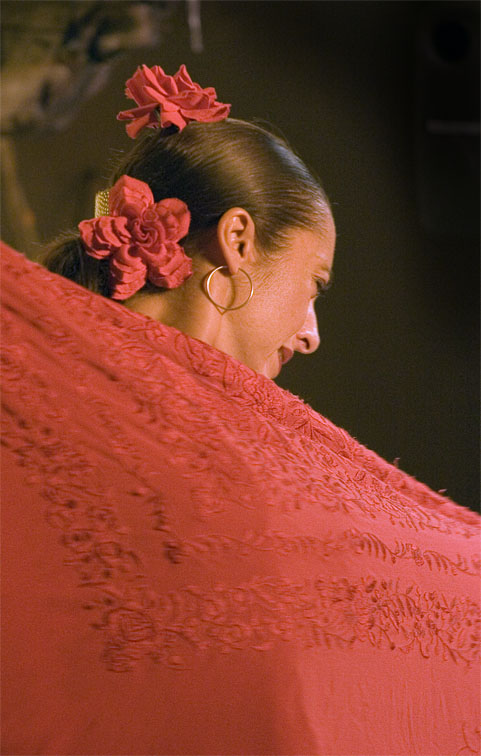
There are many Flamenco shows in Andalusia, some very much for tourists but in Seville there is a biennial Flamenco festival and I am sure the level is quite high (there were no tickets left). There are many types of Flamenco but I could not recognize the styles in the two shows I saw.
posted by Just Me in Paris at Monday, October 23, 2006




10 Comments:
It does happen in Spain, too. For a real feel of European culture, nothing beats than living in there. Great overview, you just made me feel Andalusia's beauty in Spain.
Thanks for your comment. Spain is a wonderful country and I have many fond memories of my visit there.
I have not checked in here for a while because I thought
it was getting boring, but the
last few posts are good quality so I guess
I will add you back to my everyday bloglist.
You deserve it friend :)
Feel free to surf to my web site :: 10 day weather forecast costa dorada spain
My page - temperature in javea spain in may
My coder is trying to persuade me to move to .net from PHP.
I have always disliked the
idea because of the costs. But he's tryiong none the less. I've been using Movable-type on several websites for about a year and am
nervous about
switching to another platform. I have heard excellent things about blogengine.
net. Is
there a way I can import all my wordpress content into it?
Any help would be
greatly appreciated!
Stop by my web blog 2011 Nba Draft List Of Players
Also visit my web page ... 2011 world series cardinals hats
You made some decent factors there. I appeared on the web for the problem and found most people will
go together with with your website.
Here is my web page 2011 world series schedule game 7
My web blog : 2011 world series poker final table winner
fantastic points altogether, you simply gained a brand
new reader.
What would you recommend about your post that you made a few days ago?
Any positive?
My web site ; falsealder.skybookmarks.com
I have learn several excellent stuff here. Definitely price bookmarking for revisiting.
I surprise how a lot attempt you
place to create this sort of magnificent informative site.
My web page :: varetaphunda.blogspot.fr
Hey there are using Wordpress for your site platform?
I'm new to the
blog world but I'm trying to get started and set up my own.
Do you require any coding
knowledge to make your own blog? Any help would be really appreciated!
my page: inventforum.com
I’ll right away snatch your rss as I can not in finding your e-mail
subscription hyperlink or newsletter service.
Do
you have any? Please let me recognise so that I may just subscribe.
Thanks.
Have a look at my website ... www.christtotheworld.com
That is the right blog for anyone who desires to search out out about this topic.
You
realize so much its virtually arduous to
argue with you (not that I really would want…HaHa).
You definitely put a
new spin on a subject thats been written about for
years. Nice stuff, simply
nice!
Also see my site: www.alternativedr.com
Post a Comment
<< Home